[INVESTING · FOREX · TRADING PSYCHOLOGY]
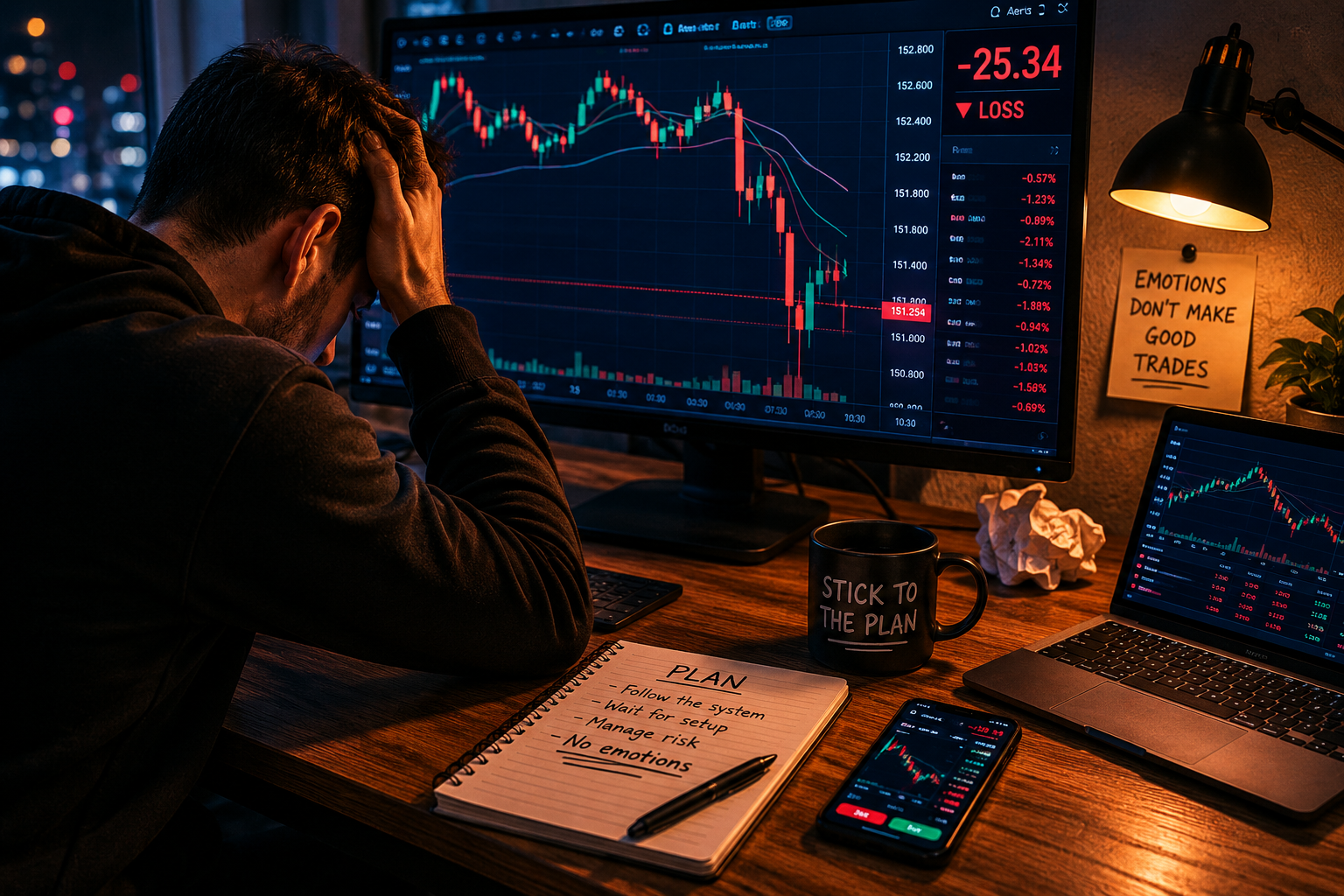
Revenge trading never feels emotional when you’re doing it. That’s probably the dangerous part.
Summary
- After a stop loss hits, my first instinct is usually trying to get back to breakeven.
- Watching profit disappear feels worse than taking a normal loss.
- Revenge trading feels logical while it’s happening.
- I’ve definitely doubled position sizes before trying to recover losses.
- Looking at charts too much makes emotional decisions far more likely.
Quick answer:
Revenge trading usually starts because you believe the original trade idea was still correct. The danger is that emotion slowly starts replacing discipline while convincing you that you’re still being logical.
The Need To Get Back To Green
When a stop loss gets hit, my natural reaction is usually trying to get back to breakeven as quickly as possible.
Even small losses annoy me more than they probably should.
I look at the weekly and monthly history on the account and seeing red trades sitting there bothers me.
Even getting the account back to something like $1 green somehow feels better mentally.
That’s probably the first dangerous thought process.
Because at that point, you’re not really thinking about good trades anymore.
You’re thinking about fixing the feeling.
Sometimes the emotional goal quietly changes from “follow the system” to “make the red disappear”.
It Feels Logical At The Time
I think this is the part most people don’t explain properly.
Revenge trading rarely feels reckless while it’s happening.
It usually feels completely justified.
After a stop loss, my thinking is normally:
- the move was just volatility
- the original direction is still correct
- price will probably recover
- I can make the loss back quickly
And honestly, sometimes that thinking is right.
That’s what makes it dangerous.
If it failed every single time, nobody would do it.
Doubling The Position
I’ve definitely doubled position sizes before after taking a loss.
The logic in my head was usually something like:
“If price only recovers a small amount, the bigger position will recover the previous loss as well.”
Sometimes it actually worked.
Which probably makes the habit worse long term.
But there have also been times where the price just continued against the position and turned a manageable loss into something much bigger.
That’s where the anxiety starts kicking in.
- do you let the trade run?
- do you move the stop loss?
- do you close early?
- are you still following the system at all?
That’s usually the point where clear thinking starts disappearing.
You Start Convincing Yourself
I’ve definitely seen myself slowly bend my own rules before.
Taking trades early.
Trying to convince myself a setup still fits the system.
Moving take profit levels higher and higher because the trade “looks strong”.
Locking in some profit, then getting annoyed when price continues without me afterwards.
The strange thing is:
subconsciously, you usually know you’re forcing it.
You can see the exact same setup 100 times before and ignore it completely.
But when emotion is involved, suddenly it feels different.
The dangerous part:
You stop trading the market and start trading your emotions instead.
I Think It’s Really About Being Wrong
Deep down, I think revenge trading mostly comes from not wanting to accept being wrong.
You want to get back on a positive run again.
You want the feeling of profits coming in consistently.
Once that momentum breaks, part of you wants to force it back immediately.
That’s where bad decisions usually start.
It’s probably similar psychologically to gambling or slot machines.
You lose a few times, then keep going because you want the winner and the feeling that comes with it.
If you’re not careful, that spiral can happen very quickly.
The Difference Between Me Now And A Few Years Ago
A few years ago, I would’ve revenge traded almost immediately after the stop loss.
Now, there’s at least more thought process behind it.
I still occasionally revenge trade, but I’m much more aware of it happening.
I’ll normally:
- wait for actual setups again
- avoid entering immediately
- check if the trade genuinely fits the system
- reduce position sizes
The biggest difference now is probably being okay with not trading.
If no setup appears, I’m fine waiting a few days before opening another trade.
That never used to happen.
Trading smaller position sizes has helped mentally as well. If I know I can’t blow the account up, it becomes easier to stay calm.
Final Thought
I still think revenge trading is probably one of the hardest parts of trading psychologically.
Not because it feels emotional.
But because it usually feels logical while it’s happening.
That’s the trap.
The difficult part isn’t understanding the system.
It’s sticking to it once emotion starts trying to take control.
I still catch myself wanting to “win it back” sometimes. The difference now is noticing it before it gets out of control.

Leave a Reply