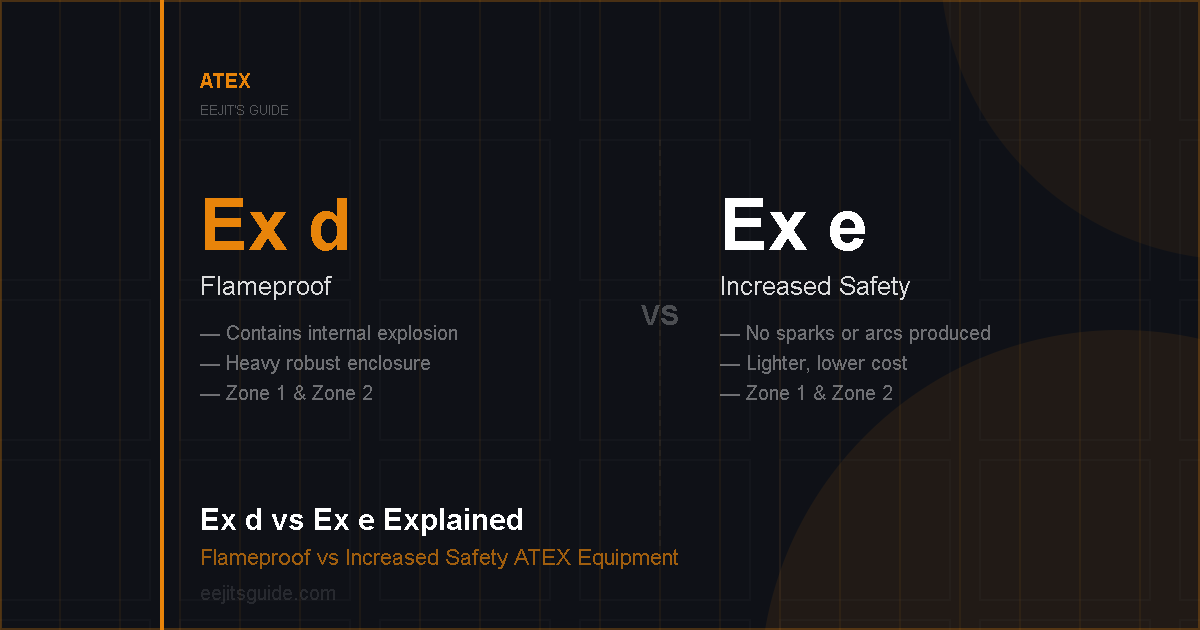
Ex d and Ex e are two common types of explosion protection used for electrical equipment in hazardous areas.
They are often mentioned together, but they work in very different ways.
The simple version is this: Ex d contains an explosion, while Ex e is designed to prevent an ignition source from occurring in the first place.
What Does Ex d Mean?
Ex d stands for flameproof enclosure.
The idea behind Ex d is that if an explosion happens inside the enclosure, the enclosure is strong enough to contain it and prevent the flame from escaping into the surrounding hazardous atmosphere.
This is why Ex d equipment is usually heavy, solid and very robust.
The enclosure, lid, bolts, cable entries and flamepaths are all part of the protection concept.
What Does Ex e Mean?
Ex e stands for increased safety.
Ex e equipment is designed so that sparks, arcs, excessive temperatures and other ignition sources should not occur during normal operation.
Rather than containing an explosion after it happens, Ex e aims to prevent the ignition source from being present in the first place.
Ex e is commonly used for junction boxes, terminals, control panels, marshalling panels, PLC panels and other equipment where suitable certified components can be used.
Ex d vs Ex e: The Simple Difference
| Protection Concept | Basic Idea | Common Use |
|---|---|---|
| Ex d | Contains an internal explosion and prevents flame escape | Motors, starters, instruments, heavy-duty enclosures |
| Ex e | Prevents ignition sources during normal operation | Junction boxes, terminals, control panels, IS marshalling panels |
A Simple Football Analogy
One way I think about Ex d and Ex e is like a football team.
Ex d is like the goalkeeper.
It is the last line of defence. If something goes wrong inside the enclosure, it is designed to stop the explosion getting out into the hazardous area.
Ex e is like the defenders.
It is trying to stop the problem happening in the first place by reducing the chance of sparks, arcs or excessive temperature.
Both roles are important. But they are not the same thing.
Is Ex e Safer Than Ex d?
Both Ex d and Ex e can be suitable when correctly selected, installed and maintained.
However, I personally prefer the Ex e concept where it is suitable because it aims to prevent ignition sources rather than contain an explosion.
That does not mean Ex e can be used everywhere. It cannot.
The correct choice depends on the hazardous area classification, equipment type, gas group, temperature class, available certified components, cost, maintainability and project requirements.
Where I Commonly See Ex d Used
In my experience, Ex d is commonly seen on equipment such as:
- Motors
- Starter panels
- Some field instruments
- Heavy-duty control equipment
- Equipment where internal sparking components may be present
Ex d equipment can be very robust, but it is often heavy, expensive and less flexible to modify.
Where I Commonly See Ex e Used
Ex e is commonly used for:
- Junction boxes
- IS marshalling panels
- PLC panels
- Terminal boxes
- Control panels
- Panels using appropriately certified components
Ex e equipment can be suitable for Zone 1 and Zone 2 applications when correctly specified and certified.
In practice, Ex e can often be more flexible than Ex d because there is a wider range of certified components available and modifications may be easier to manage.
Common Ex d Mistake: Missing Bolts
One of the real-world issues I have seen with Ex d panels is missing bolts.
This can happen after a panel has been opened for wiring or maintenance. There can be a lot of bolts on an Ex d enclosure, and if one gets lost, someone may assume it is not a big deal.
It can be tempting to think of it like hanging a picture frame. If it has four screws and one is missing, the frame might still stay on the wall.
Ex d does not work like that.
Common Ex d Mistake: Treating It Like a Normal Box
Another mistake is assuming that because something is Ex d, you can add whatever you want inside it.
That is not how certified equipment works.
If you change the components, layout, cable entries, power dissipation or construction, you may affect the certification.
This is one of the reasons Ex d panels can be painful to modify. Changes may require design review, manufacturer approval or recertification.
Common Ex d Inspection Issues
Ex d equipment needs proper inspection and maintenance.
Common issues include:
- Missing bolts
- Incorrect bolts
- Damaged flamepaths
- Paint on flamepaths
- Swarf or debris on flamepaths
- Incorrect cable glands
- Unused entries not correctly stopped
- Corrosion or mechanical damage
Flamepaths are especially important. They should be clean, undamaged and maintained according to the manufacturer’s instructions.
Common Ex e Mistake: Using Normal Components
Ex e panels are generally more flexible than Ex d, but they are not just normal panels with an ATEX label stuck on.
The components inside still need to be suitable for the certified design.
I have seen Ex e panels with normal terminals and normal fuses installed where certified components should have been used.
In fairness, this can catch people out because some components look almost identical. A certified fuse holder and a non-certified fuse holder may look very similar, but the marking and certification matter.
Common Ex e Mistake: Poor Segregation
Segregation is another issue I have seen many times.
For example, standard wiring trunking may be tight up against intrinsically safe wiring trunking, or cables may enter the panel too close together.
In hazardous area equipment, wiring layout and segregation are not just neatness issues. They can form part of the safety concept and inspection requirements.
Common Ex e and IS panel issues include:
- Standard trunking too close to IS trunking
- Poor separation between circuits
- Incorrect cable routing
- Cable entries too close together
- Incorrect terminals
- Non-certified components used inside the panel
Why I Usually Prefer Ex e Where Suitable
Given the choice, I would generally lean towards Ex e where it is suitable for the application.
The reasons are practical:
- It is generally more flexible.
- There is often a wider range of Ex rated components available.
- Can be easier to maintain.
- It may be easier to modify with the right design controls.
- May avoid some of the heavy mechanical restrictions of Ex d.
- Lead times may be better than some Ex d equipment.
Ex d equipment can be very heavy and awkward to work with. Even opening a large Ex d enclosure can be time-consuming if there are twenty or more bolts to remove.
That does not make Ex d bad. It just means it should be selected for the right reasons.
Why ATEX Equipment Costs More Than Clients Expect
One thing clients often underestimate is the cost and design effort involved in ATEX equipment.
Sometimes hazardous area requirements are treated as an afterthought. Sometimes they are not considered early enough at all.
Then later someone realises:
- Panel needs hazardous area certification.
- Components are not suitable.
- Glands are wrong.
- Layout needs redesign.
- Equipment needs inspection before it can be accepted.
The U Certificate Trap
Another issue I have seen is people buying components with U certificates and assuming that means the finished assembly is certified.
A U certificate usually means the item is a component, not a complete certified piece of equipment ready to be installed on its own.
The final assembly may still need additional assessment, documentation and certification.
Ex d vs Ex e: Which Should You Choose?
There is no single answer that applies to every project.
The right choice depends on:
- Hazardous area zone
- Gas group
- Temperature class
- Equipment function
- Available certified components
- Maintenance requirements
- Modification requirements
- Lead time
- Cost
- Inspection requirements
Ex d can be the correct solution where flameproof protection is required or where the equipment type suits that protection method.
Ex e can be a better fit where increased safety components and design rules can be used to prevent ignition sources.
The goal is not to pick the protection concept that sounds the toughest. The goal is to choose the protection concept that is correct for the hazardous area, the equipment and the project.
Quick Checklist Before Selecting Ex d or Ex e Equipment
Before selecting or approving equipment, I would check:
- What hazardous area zone is the equipment going into?
- Is Ex d or Ex e suitable for the application?
- Are there any X certificate conditions?
- What gas group is required?
- Can the equipment be maintained easily?
- What temperature class is required?
- Is the full equipment certified, not just a component?
- Are all cable entries, glands and stopping plugs suitable?
- Will future modifications be required?
- Has the actual certificate been checked, not just the datasheet?
Frequently Asked Questions About Ex d and Ex e
What is the difference between Ex d and Ex e?
Ex d is flameproof protection and is designed to contain an internal explosion. Ex e is increased safety protection and is designed to prevent ignition sources such as sparks, arcs and excessive temperatures during normal operation.
Is Ex d better than Ex e?
Not automatically. Ex d and Ex e are different protection concepts. The correct choice depends on the hazardous area, equipment type, gas group, temperature class, maintenance requirements and certification.
Is Ex e safer than Ex d?
Both can be safe when correctly selected, installed and maintained. Personally, I prefer Ex e where suitable because it aims to prevent ignition sources rather than contain an explosion after it has happened.
Can Ex e be used in Zone 1?
Ex e equipment can be suitable for Zone 1 if it is correctly certified for that use. Always check the full equipment marking, certificate and conditions of use.
Can you modify an Ex d panel?
Ex d panels are usually difficult to modify because changes can affect the certified design. Modifications may require manufacturer approval, design review or recertification.
Why are missing bolts a problem on Ex d equipment?
Ex d equipment relies on the enclosure being complete and correctly assembled. Missing bolts can affect the flameproof integrity of the enclosure and may compromise certification.
Can normal terminals be used in an Ex e panel?
No, not unless they are suitable for the certified design. Ex e panels must use components that are appropriate for the certification, installation and intended use.
Final Thoughts
Ex d and Ex e are both important protection concepts, but they should not be treated as interchangeable.
Ex d is about containing an explosion. Ex e is about preventing ignition sources from occurring in the first place.
In real projects, the problems usually come from assumptions:
- Assuming
- ATEX means suitable.
- Ex d can be modified like a normal enclosure.
- Ex e components are the same as standard components.
- Inspection details like bolts, glands and segregation do not matter.
My simple rule is this: choose the protection concept deliberately. Do not pick Ex d or Ex e because it sounds better. Pick it because it is suitable, certified, maintainable and correct for the hazardous area.
You may also find these useful:



Leave a Reply