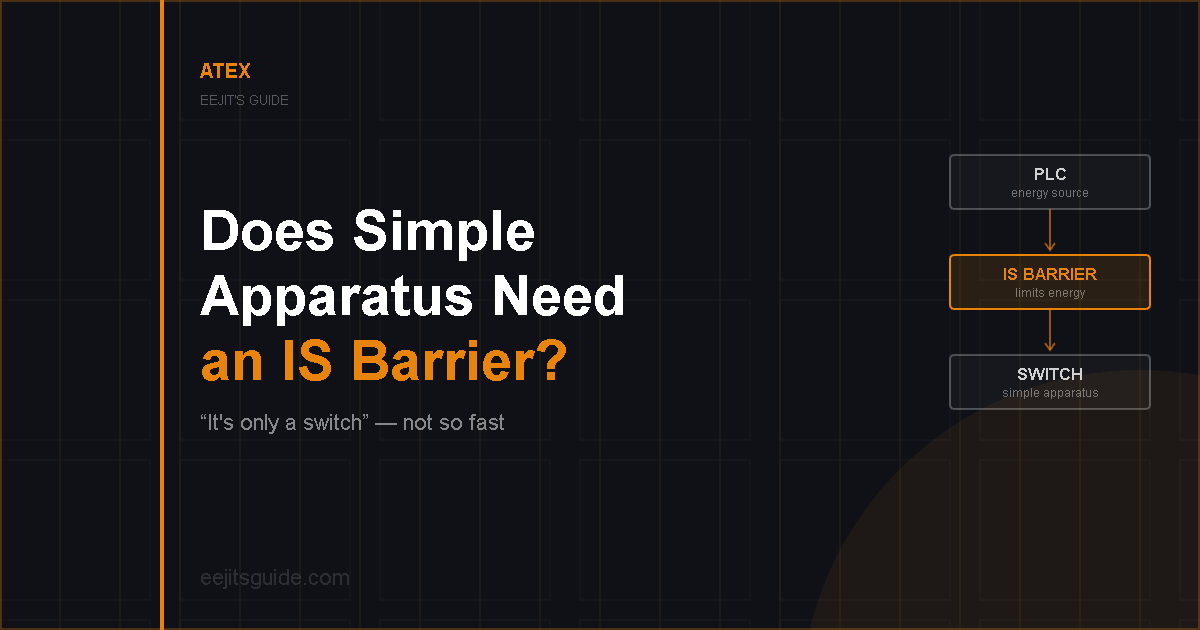
Simple apparatus is one of those subjects in hazardous-area work that sounds simple
until somebody says:
“It’s only a switch. It doesn’t need a barrier.”
I’ve had this argument more than once.
A pushbutton, dry contact, Pt100 or thermocouple may qualify as
simple apparatus. That can mean the device itself does not require
conventional Ex certification when it is used correctly as part of an intrinsically
safe circuit.
What it does not mean is that we can connect it to any old electrical
circuit, run the cable into a hazardous area and declare the installation safe.
Simple apparatus does not make a circuit intrinsically safe.
The complete circuit still has to be intrinsically safe.
First: What Is Simple Apparatus?
In intrinsic safety, simple apparatus covers relatively simple electrical components
whose electrical characteristics are sufficiently well defined that they can be
assessed as part of the intrinsically safe system.
Typical examples can include:
- Switches
- Pushbuttons
- Dry contacts
- Terminals and junction boxes
- Resistance temperature detectors such as Pt100s
- Thermocouples
- Simple passive components
There are also limits applying to simple apparatus that can generate energy.
The familiar values associated with the simple-apparatus concept are
1.5 V, 100 mA and 25 mW.
But none of this tells us how much electrical energy can arrive at the device
from somewhere else.
“But It’s Only a Switch!”
Imagine we install a basic mechanical switch in Zone 1.
The switch contains no power supply. It doesn’t have a battery. It isn’t deliberately
generating sparks. It is about as simple as electrical equipment gets.
So somebody says:
“It’s simple apparatus. It doesn’t need a barrier.”
There is a rather important question missing:
Because the switch may not be supplying the energy.
The control system might be.
The Eejit’s Circuit
Ordinary PLC Input
       │
       │
       │  Cable into Zone 1
       │
       ▼
   ┌─────────┐
   │ Switch  │
   └─────────┘
 Simple apparatus
Calling the switch simple apparatus has not magically converted the PLC input circuit
into an intrinsically safe circuit.
If the PLC circuit can supply sufficient voltage, current or stored energy under the
relevant normal and fault conditions to cause ignition, we have a problem.
The fact that the field device consists of two bits of metal touching each other
doesn’t change that.
What the Barrier Is Actually Doing
An intrinsic safety barrier is not fitted because the field switch is particularly
dangerous.
Its job is to make sure that the electrical energy which can reach the hazardous area
is restricted to an intrinsically safe level.
A typical arrangement might therefore look like this:
Ordinary PLC
     │
     ▼
┌──────────────┐
│  IS Barrier  │
│ / Isolator   │
└──────────────┘
     │
     │ Intrinsically safe circuit
     │
     ▼
┌──────────────┐
│ Field Switch │
└──────────────┘
 Simple apparatus
The barrier controls the energy entering the intrinsically safe circuit.
The barrier isn’t there because the switch is simple apparatus.
The barrier is there because the energy entering the hazardous area needs to be controlled.
So Does Simple Apparatus Always Need a Separate Barrier?
No.
And this is where we need to be careful not to replace one oversimplification
with another.
You do not necessarily need a separate DIN-rail module labelled
INTRINSIC SAFETY BARRIER.
For example, the control system may already have a suitably certified intrinsically
safe input or output.
┌───────────────────────┐
│ Certified Ex i Input  │
└───────────────────────┘
           │
           │ Intrinsically safe circuit
           │
           ▼
      ┌──────────┐
      │  Switch  │
      └──────────┘
    Simple apparatus
In that situation, adding another external barrier simply because someone said
“simple apparatus needs a barrier” may achieve nothing useful.
The necessary energy limitation is already being provided by the certified
intrinsically safe circuit.
Barrier the Box vs Barrier the Function
This is probably the easiest way to understand the whole subject.
| Statement | Verdict |
|---|---|
| Simple apparatus always requires a separate physical barrier module. | Wrong |
| Simple apparatus can be connected to an ordinary circuit because it is simple apparatus. | Wrong |
| The complete Ex i circuit needs suitable energy limitation. | Correct |
| The energy limitation could be provided by a Zener barrier. | Correct |
| The energy limitation could be provided by a galvanic isolator. | Correct |
| The energy limitation could already be incorporated into certified Ex i I/O. | Correct |
Example 1: A Dry Contact
We have a simple mechanical level switch installed in a hazardous area.
There may be very little of interest electrically inside the switch itself.
It may quite legitimately be considered simple apparatus.
But if we connect that contact directly to a normal 24 V control circuit,
declaring the contact “simple apparatus” does not prove intrinsic safety.
If we are using Ex i as our method of protection, the circuit supplying
the contact needs to meet the intrinsic-safety requirements.
Example 2: A Pt100
A basic Pt100 is another classic example of simple apparatus.
Again, the interesting question isn’t merely:
“Is the Pt100 simple apparatus?”
We also need to ask:
“What circuit is supplying the Pt100, and has the complete circuit been assessed
as intrinsically safe?”
A certified Ex i temperature input may provide the necessary energy limitation directly.
Alternatively, an appropriate associated apparatus or isolator may be installed between
the control system and the hazardous-area circuit.
Example 3: A Thermocouple
A thermocouple is slightly different because it actually generates a small electrical
voltage.
The simple-apparatus rules recognise small sources of generated energy, which is where
the familiar 1.5 V, 100 mA and 25 mW limits become relevant.
But the complete circuit still needs considering.
Simple apparatus is not a magic phrase which allows us to stop doing the intrinsic
safety assessment.
Don’t Forget the Cable
There is another reason why looking only at the field device is dangerous.
An intrinsically safe circuit isn’t just:
Barrier + Device
It also includes the interconnecting wiring.
Cable capacitance and inductance can store energy, so these values have to be considered
when verifying the intrinsically safe circuit.
Depending on the arrangement, parameters such as the maximum output voltage,
current, power, capacitance and inductance permitted by the associated apparatus
have to be checked against the characteristics of the connected circuit.
In other words:
Why the Confusion Happens
I suspect most arguments over simple apparatus begin with a perfectly correct statement:
“Simple apparatus doesn’t require normal Ex certification.”
Unfortunately, somewhere along the way this becomes:
“Simple apparatus doesn’t need intrinsic safety protection.”
Those are not the same statement.
The exemption relating to the simple field component does not provide an exemption
from designing and verifying the intrinsically safe circuit correctly.
The Question You Should Actually Ask
Rather than asking:
“Does this switch need a barrier?”
ask:
“What limits the energy in this circuit, and can I demonstrate that the complete
circuit is intrinsically safe?”
If the answer is a Zener barrier, fine.
If the answer is a galvanically isolated IS interface, fine.
If the answer is a certified Ex i input built into the control system, also fine.
If the answer is:
“Nothing, but don’t worry because it’s only a switch.”
Then we probably need to have a chat.
The Eejit’s Summary
- Simple apparatus may not require its own conventional Ex certification.
- That does not make whatever circuit it is connected to intrinsically safe.
-
Intrinsic safety depends on controlling the electrical and stored energy available
in the hazardous area. - A Zener barrier or galvanic isolator is a common way of achieving this.
-
A separate barrier module isn’t always necessary if suitable certified Ex i
circuitry already provides the energy limitation. - The cable and its capacitance and inductance form part of the assessment.
- The complete intrinsically safe circuit should be verified and documented.
Simple apparatus describes the apparatus.
It does not automatically make the circuit intrinsically safe.
Relevant Standards
For further reading, the principal IEC standards relevant to this subject include:
-
IEC 60079-11:2023 – Explosive atmospheres – Part 11:
Equipment protection by intrinsic safety “i”. -
IEC 60079-14:2024 – Explosive atmospheres – Part 14:
Electrical installation design, selection and installation of equipment,
including initial inspection. -
IEC 60079-25 – Explosive atmospheres – Part 25:
Intrinsically safe electrical systems.
This article is intended as an introduction to the principle and should not replace
the applicable standards, equipment certificates, control drawings or a competent
assessment of a particular installation.




Leave a Reply