ATEX temperature classes are one of those things that look simple on paper but still catch people out in the real world.
You see a table with T1, T2, T3, T4, T5 and T6, and it is easy to assume the higher number means the most dangerous area or that T1 must be the best rating.
That is not how it works.
What Is an ATEX Temperature Class?
An ATEX temperature class, often called a T-rating or T-class, defines the maximum surface temperature that a piece of equipment can reach under its certified operating conditions.
This matters because hazardous gases and vapours can ignite if they come into contact with a hot enough surface.
The temperature class is there to make sure the equipment surface temperature stays below the ignition temperature of the hazardous atmosphere.
ATEX Temperature Class Table
The standard temperature classes are shown below.
| Temperature Class | Maximum Surface Temperature |
|---|---|
| T1 | 450°C |
| T2 | 300°C |
| T3 | 200°C |
| T4 | 135°C |
| T5 | 100°C |
| T6 | 85°C |
The key point is this:
T1 gets the hottest. T6 stays the coolest.
Common Mistake: Thinking T1 Is Better Than T6
One of the easiest mistakes to make is reading the table the wrong way round.
Because T1 has the lowest number, it can look like the highest or safest rating. In reality, T1 allows the equipment to reach a much higher surface temperature than T6.
A T1 device can reach up to 450°C. A T6 device is limited to 85°C.
Think of it like two light bulbs.
Bulb A is rated T6 and can reach up to 85°C.
Bulb B is rated T1 and can reach up to 450°C.
If you had a flammable gas or vapour nearby, which one would you rather have in the light fitting?
That is the basic idea behind temperature classes. The lower the maximum surface temperature, the safer the equipment is from an ignition temperature point of view.
Temperature Class Is Not the Same as Zone Classification
Temperature class and zone classification are related to hazardous areas, but they describe completely different things.
- Zone classification tells you how likely a hazardous atmosphere is to be present.
- Temperature class tells you how hot the equipment surface can get.
For example, you could have equipment installed in Zone 1 with a T4 temperature class, or equipment in Zone 2 with a T6 temperature class.
The zone does not automatically tell you the temperature class. You need to check both.
Common Mistake: Assuming ATEX Means Suitable
Another common mistake is assuming that if a device is ATEX rated, it can be used in any hazardous area.
That is not true.
ATEX rated equipment still needs to be suitable for the specific hazardous area where it is being installed.
You need to check:
- Zone or equipment category
- Gas group
- Temperature class
- Equipment Protection Level
- Ambient temperature range
- Certificate conditions
Example: Ethanol and Temperature Class
Ethanol is a good practical example, especially in distillery and process environments.
Ethanol has an auto-ignition temperature of approximately 365°C. That means equipment with a maximum surface temperature above this could be a problem.
| Temperature Class | Maximum Surface Temperature | Suitable for Ethanol? |
|---|---|---|
| T1 | 450°C | No |
| T2 | 300°C | Yes |
| T3 | 200°C | Yes |
| T4 | 135°C | Yes |
| T5 | 100°C | Yes |
| T6 | 85°C | Yes |
In this example, T1 would not be suitable because the equipment could reach 450°C, which is above the ignition temperature of ethanol.
T2 or better would normally be suitable from a temperature class point of view, because the maximum surface temperature is below the ignition temperature of ethanol.
Example Substances and Temperature Classes
The table below gives a few common example substances and approximate auto-ignition temperatures.
Always use your project documentation, hazardous area classification study, safety data sheets and applicable standards when selecting real equipment. These values are only to help explain the principle.
| Substance | Typical Use or Location | Approx. Auto-Ignition Temperature | Typical Minimum T-Class |
|---|---|---|---|
| Hydrogen | Chemical, energy, process industries | Approx. 560°C | T1 |
| Methane | Oil, gas and process industries | Approx. 537°C | T1 |
| Ethanol | Distilleries, pharmaceutical and process industries | Approx. 365°C | T2 |
| Acetylene | Cutting, welding and industrial gas applications | Approx. 305°C | T2 |
| Ammonia | Refrigeration, chemical and process industries | Approx. 630°C | T1 |
| Propane | Fuel gas, LPG and industrial applications | Approx. 470°C | T1 |
| Carbon Disulfide | Specialist chemical applications | Approx. 90-100°C | T6 |
Why T6 Exists
In many projects, you may mostly come across T4, T5 or T6 equipment. T1 equipment is less common in my experience.
T6 exists because some substances have very low ignition temperatures.
Carbon disulfide is a good example. Its auto-ignition temperature is around 90-100°C, which means T5 equipment at 100°C can be too close or unsuitable depending on the required assessment.
T6 equipment is limited to 85°C, which gives a lower maximum surface temperature.
Ambient Temperature Can Change the T-Rating
This is one of the more important real-world details.
A device’s temperature class is not always fixed. On many ATEX certificates, the temperature class depends on the ambient temperature range.
For example, a certificate might show something like this:
| Ambient Temperature Range | Certified Temperature Class |
|---|---|
| -40°C to +60°C | T4 |
| -20°C to +40°C | T5 |
| -20°C to +20°C | T6 |
The equipment has not changed. The certified operating conditions have.
At a lower ambient temperature, the device may run cooler and achieve a better temperature class. At a higher ambient temperature, the same device may only be certified to T4.
Check the Certificate Conditions
The nameplate is important, but it does not always tell the full story.
ATEX certificates can include conditions that affect installation, use and temperature classification.
Pay particular attention to:
- Ambient temperature range
- Temperature class tables
- Specific conditions of use
- Certificate supplements
- Mounting orientation
- Power limitations
- Whether the certificate number includes an X
The X on a certificate number usually means there are specific conditions of use. These conditions can be very important.
Associated Apparatus Can Also Matter
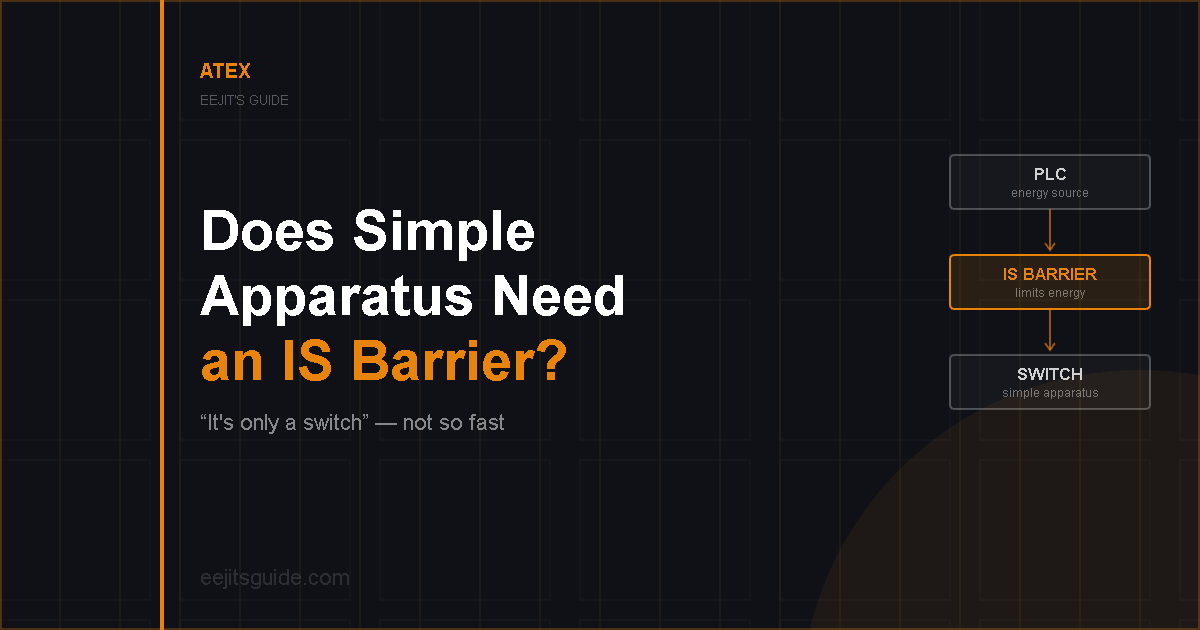
With intrinsically safe systems, people often focus on the field instrument and forget about the associated apparatus.
In many installations, the associated apparatus, such as an IS barrier, is installed in the safe area. But that is not always the case.
There may be situations where the field instrument is in Zone 1, while a panel containing the barrier is installed in Zone 2 due to distance, access or site layout.
In that case, the barrier is also installed in a hazardous area and its own marking and temperature class must be checked.
Imagine a level transmitter installed in Zone 1 with a T6 temperature class.
The associated barrier is installed in a Zone 2 panel and has a T4 temperature class.
The transmitter may be suitable, but the barrier still needs to be assessed because it is also located in the hazardous area.
Some equipment can have separate markings for where it can be mounted and what it can transmit to or from. This is why reading the certificate properly matters.
Why This Should Be Checked During Design
Temperature class should be checked during the design and specification stage, not after the equipment has arrived on site.
Getting this right early can save a lot of time and money.
- It avoids buying unsuitable equipment.
- It reduces the chance of ATEX inspection failures.
- It prevents delays during commissioning.
- It avoids replacing long-lead-time instruments.
- It gives the site team more confidence during installation.
This is especially important when there are lots of instruments to procure and the project is under time pressure.
Cost vs Over-Specifying Equipment
There is also a balance to strike.
Buying IIC T6 equipment for every application may sound safe, but it can be more expensive than necessary.
If the area only requires a less restrictive temperature class and gas group, the higher specification may not provide any practical benefit.
It is a bit like buying the top-spec version of a car when the entry-level model would do the same job.
There are times when you need the top specification, but there are also times when it is simply unnecessary cost.
The goal is not to buy the highest rating every time. The goal is to buy equipment that is correctly specified for the hazardous area.
Quick Checklist for ATEX Temperature Classes
Before selecting equipment, I would check:
- What hazardous gas or vapour is present?
- What is the ignition temperature of that gas or vapour?
- What temperature class is required?
- What is the equipment’s certified T-rating?
- Does the T-rating change with ambient temperature?
- Is the equipment installed in the hazardous area?
- Is any associated apparatus also in the hazardous area?
- Are there any X certificate conditions?
- Has the actual certificate been checked, not just the datasheet?
Do not trust that a device is suitable just because it says ATEX on the datasheet or nameplate. ATEX is not a blanket approval for every hazardous area.
Frequently Asked Questions About ATEX Temperature Classes
What does T4 mean on ATEX equipment?
T4 means the equipment has a maximum surface temperature of 135°C under its certified operating conditions.
Is T6 better than T4?
T6 has a lower maximum surface temperature than T4, so it is more restrictive from a surface temperature point of view. T6 equipment is limited to 85°C, while T4 equipment is limited to 135°C.
Is T1 better than T6?
No. T1 allows a maximum surface temperature of 450°C, while T6 is limited to 85°C. T6 is the cooler and more restrictive temperature class.
Does temperature class mean the equipment normally runs at that temperature?
No. The temperature class defines the maximum surface temperature the equipment is certified not to exceed. It is not necessarily the normal operating temperature.
Can the temperature class change with ambient temperature?
Yes. Many ATEX certificates provide different temperature classes for different ambient temperature ranges. Always check the certificate conditions.
Can T4 equipment be used with ethanol?
From a temperature class point of view, T4 equipment is generally below the auto-ignition temperature of ethanol. However, the full equipment marking, gas group, zone suitability, ambient temperature and certificate conditions must still be checked.
Why is carbon disulfide often used as a T6 example?
Carbon disulfide has a very low auto-ignition temperature of around 90-100°C. This makes it a useful example for showing why T6 equipment, limited to 85°C, may be required.
Final Thoughts
ATEX temperature classes are not complicated once the principle makes sense.
The T-rating tells you the maximum surface temperature the equipment can reach. It does not tell you the zone, it does not tell you the gas group, and it does not automatically mean the equipment is suitable.
The most important thing is to check the actual requirements against the actual equipment certification.
My simple rule is this: do not assume equipment is suitable for a hazardous area just because it says ATEX. Check the zone, gas group, temperature class, ambient range and certificate conditions before buying or installing it.
You may also find these useful:



Leave a Reply