INVESTING · REAL WORLD
This article is based on my own experience. I am not a financial advisor, and this is not financial advice. Investments can go down as well as up, and you should always do your own research or speak to a qualified professional if you are unsure.
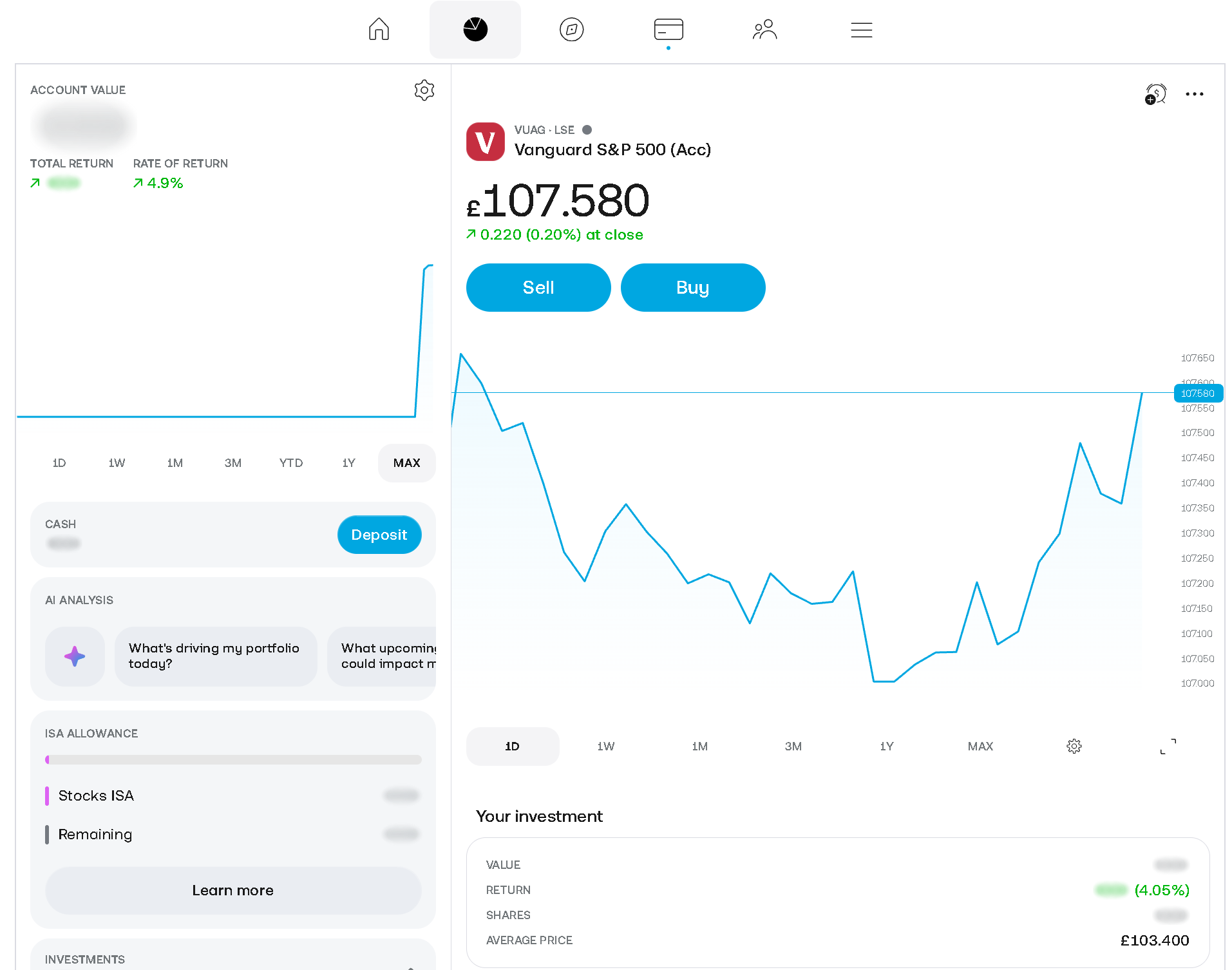
I first started investing in VUAG around 2023 through my normal trading account. At the time, it made sense to me as a simple long-term investment, but it was not the most tax-efficient way to hold it.
More recently, I opened a Stocks and Shares ISA with Trading 212, and VUAG became the main investment I wanted to hold inside it.
The reason is simple: I want a long-term investment that gives me exposure to strong US companies, automatically reinvests dividends, and does not need constant management from me.
Summary
- VUAG is an accumulating ETF from Vanguard that tracks the S&P 500.
- It gives exposure to many of the largest US companies, including businesses like Apple, Microsoft and AMD.
- I chose VUAG because I wanted long-term growth, low management, and automatic dividend reinvestment.
- For me, VUAG suits a buy-and-hold strategy rather than short-term trading.
- I plan to invest around £200 per month into VUAG and increase this when I can.
- The biggest risk is not the normal ups and downs of the market, but panicking and selling at the wrong time.
New to investing?
Read my experience opening a Stocks and Shares ISA
What Is VUAG?
VUAG is the Vanguard S&P 500 UCITS ETF accumulating version. In simple terms, it is an exchange-traded fund that aims to track the S&P 500.
The S&P 500 is made up of around 500 of the largest listed companies in the United States. By buying VUAG, I am not just buying one company. I am buying a small piece of many large US companies through one fund.
That includes exposure to companies such as Apple, Microsoft, Nvidia, Amazon, Meta, Alphabet and other major US businesses.
The important part for me is that VUAG is an accumulating ETF. That means dividends are not paid out to me as cash. Instead, they are reinvested inside the fund automatically.
For my strategy, automatic reinvestment is a benefit. I am not trying to take income from the investment now. I want it to build over time.
Why I Chose VUAG Instead of VUSA or VOO
When I was looking into S&P 500 funds, I looked at options such as VUSA and VOO as well.
VUAG felt more aligned with what I wanted to do.
VOO is a US-listed ETF, which made it less suitable for me as a UK investor. VUSA is also a Vanguard S&P 500 ETF, but it is the distributing version, meaning dividends are normally paid out rather than automatically reinvested.
Because I wanted to keep things simple and invest for the long term, VUAG made more sense to me.
- It is available to UK investors.
- It trades on the London Stock Exchange.
- It tracks the S&P 500.
- It automatically reinvests dividends.
- It needs very little management from me.
That combination is what made it stand out.
Why I Prefer VUAG Over a Global Fund
I know some investors prefer global funds because they spread money across more countries and markets.
That is a completely reasonable approach, but personally, I feel the US stock market is stronger than the global market overall. The largest companies in the world are mostly US companies, and many of them operate internationally anyway.
For that reason, I am comfortable having a large part of my long-term investment focused on the US market.
It does mean I am more exposed to the performance of US companies and the US economy. I understand that risk, but for me, the potential long-term growth is worth it.
This is not me saying a US-only approach is right for everyone. It is just the approach that makes sense for me, based on how I see the market and what I want from the investment.
Why VUAG Fits My Strategy
My plan for VUAG is simple: buy it regularly and hold it for years.
This is not something I want to trade in and out of. I use other accounts for active trading. VUAG is for long-term investing.
The main things I wanted were:
- Simple exposure to the S&P 500
- Automatic dividend reinvestment
- Low ongoing costs
- Minimal management
- A long-term buy-and-hold investment
That is why it suits me. I can focus on trading elsewhere, while VUAG stays as the steady long-term part of my investing plan.
Why Fees Matter to Me
One of the reasons I did not want a managed fund was the cost.
A percentage fee might not sound like much when the account is small, but if the account grows over time, that fee can become a much bigger number. In my opinion, if the goal is to build wealth, losing more money than necessary to fees is counterproductive.
VUAG has a low ongoing charge, which is one of the reasons it appealed to me. Holding it through Trading 212 was also attractive because Trading 212 does not charge commission or custody fees on its Invest and ISA accounts, although there can still be costs such as a foreign exchange fee when buying assets in another currency.
For me, lower fees mean more of the money stays invested.
How Much I Plan to Invest
At the moment, my plan is to put £200 per month into VUAG through my Stocks and Shares ISA.
When I can comfortably increase that amount, I will.
I may also put around £20 or so into individual stocks because I enjoy picking companies and treating it as a personal challenge. But that will be a much smaller part of the account.
Roughly speaking, I expect around 90% of my long-term investing money to go into something like VUAG consistently, with a smaller amount left for individual stock picking.
My active trading and my long-term investing are separate. VUAG is not part of my short-term trading plan.
What Return Am I Expecting?
Over the long term, I am aiming for around 8% per year on average.
That does not mean I expect 8% every year. Some years will be better. Some years will be worse. There will also be downturns where the account drops in value.
The important part for me is the average over a long period, such as 10 to 15 years.
I am not trying to time the market with VUAG. I believe steady investing over years is more realistic than trying to perfectly buy the bottom and sell the top.
How I Think About Market Crashes
Market crashes can happen. Nobody has a crystal ball.
I already know there will be periods where my account goes down. That is part of investing, and I would rather accept that now than panic when it happens.
Because my plan is long term, I have no issue continuing to invest during a downturn. In fact, if I am buying every month, a falling market means I am buying at lower prices.
The key for me is not to sell just because the account is down.
The biggest mistake I could make: selling my VUAG position during a downturn because I have panicked, then trying to buy back later at the perfect time.
Why I Do Not Check the App Every Day
One thing I am trying to avoid is constantly checking the account.
If I open the app every day, I am more likely to react emotionally to short-term movements. That is not what this account is for.
I have already prepared myself for the fact that I might open the app one day and see the account has gone down.
The strategy does not change because of that.
Unless something major changes in my own circumstances or in the investment itself, the plan is to keep buying and holding.
Why I Still Pick Individual Stocks
I do enjoy choosing individual stocks.
There is a personal challenge in trying to pick good companies and beat the market. That interests me, and I do not want to remove that completely.
However, I also know that picking individual stocks comes with more risk and more effort.
That is why I want the majority of my long-term investing money going into VUAG or something similar, while keeping a smaller amount for individual shares.
For me, that feels like a good balance.
Would I Recommend VUAG to Beginners?
I think VUAG can suit beginners, especially those who want a simple buy-and-hold investment.
It removes a lot of the complications that come with picking individual stocks. Instead of trying to decide which company will perform best, you are buying a fund that tracks a major index.
That said, beginners still need to understand the risks.
The value can go down. There will be bad years. You need to be comfortable holding through downturns and not selling just because the market has dropped.
For me, the whole point of VUAG is long-term consistency.
Final Thought
VUAG suits what I want from investing.
It gives me exposure to the US stock market, automatically reinvests dividends, keeps things simple, and allows me to invest regularly without overthinking every decision.
I first bought VUAG in my normal trading account around 2023, but holding it inside a Stocks and Shares ISA now makes more sense for me because of the tax efficiency.
The plan is not complicated. I want to keep buying, hold for years, ignore the short-term noise, and let the investment do its job over time.
For me, that is exactly what long-term investing should look like.
Want to see why I opened a Stocks and Shares ISA?
Read my Stocks and Shares ISA experience
FAQs
What is VUAG?
VUAG is the Vanguard S&P 500 UCITS ETF accumulating version. It aims to track the S&P 500 and automatically reinvests dividends inside the fund.
Is VUAG good for beginners?
VUAG may suit beginners who want a simple long-term investment and are comfortable with the risks of investing in the stock market. It is not risk-free, and the value can go down as well as up.
What is the difference between VUAG and VUSA?
Both track the S&P 500, but VUAG is accumulating, while VUSA is distributing. VUAG reinvests dividends automatically, whereas VUSA normally pays dividends out to investors.
Why did I choose VUAG instead of VOO?
VOO is a US-listed ETF. As a UK investor, I preferred VUAG because it is available on the London Stock Exchange and fits better with how I want to invest.
How much do I invest in VUAG each month?
My current plan is to invest £200 per month into VUAG and increase this amount when I can comfortably afford to do so.
Do I expect VUAG to go up every year?
No. I expect the value to rise and fall over time. My aim is to hold for years and focus on the long-term average rather than short-term movements.
Is this financial advice?
No. This article is only my personal experience and opinion. I am not a financial advisor. Always do your own research or speak to a qualified professional if you are unsure.

Leave a Reply